Alex Shnaiderman Opens Solo Show 'Blue and Green' in Tel Aviv
The artist's debut solo show explores themes of family and spatial tension through layered oil paintings, delayed by the recent conflict but enriched by the pause.
By Alina Salazar ·
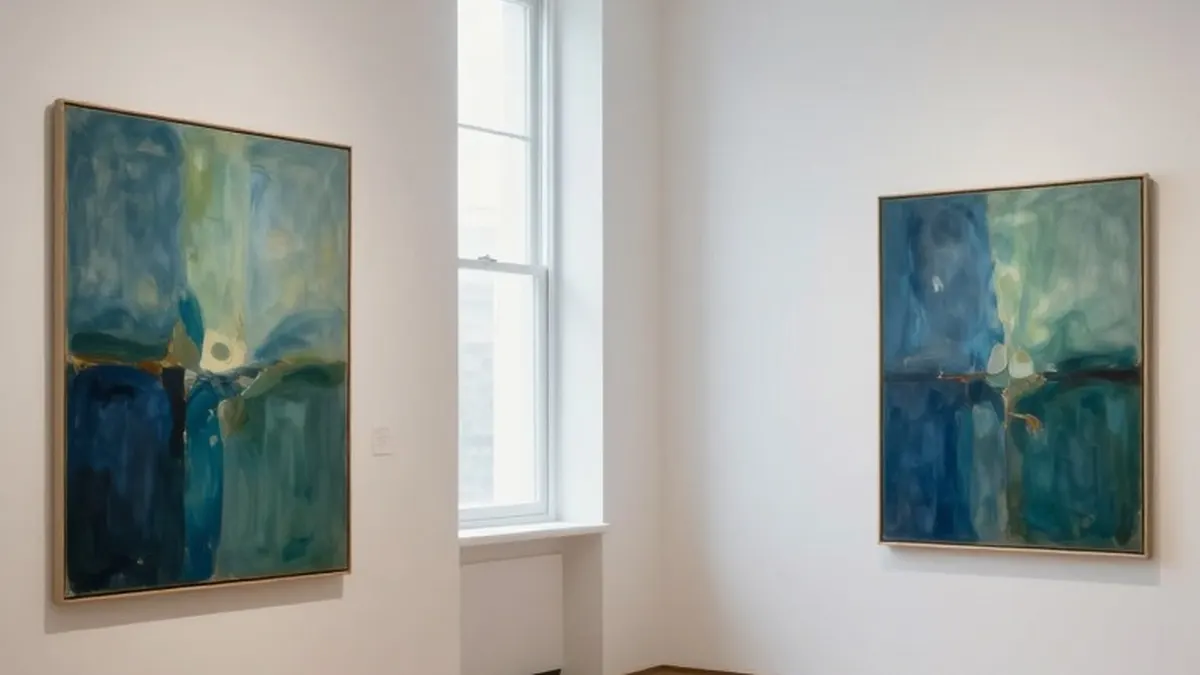
Alex Shnaiderman has opened her first solo exhibition, titled Blue and Green, at Rothschild Fine Art in Tel Aviv. The show, which launched on November 19, features oil paintings on linen that explore themes of family, intimacy, and spatial tension. Naama Arad served as the curatorial adviser for the presentation.
The exhibition was originally planned for April, but the war with Iran delayed its opening. During the postponement, Shnaiderman, her partner Alexander Gad, and their two young daughters remained in their Allenby Street apartment. The building lacks a bomb shelter, so the family stayed in an interior room for safety. Shnaiderman noted that the wait provided time to refine her work, allowing several strong pieces to emerge from the intense atmosphere.
Shnaiderman describes her artistic process as a balance between strict discipline and creative freedom. A practitioner of Aikido and Japanese calligraphy, she applies the martial arts concept of Shu-Ha-Ri to her painting. She currently occupies the middle stage, where she questions established rules and moves toward greater abstraction. Her calligraphy training has given her a precise sense of spatial measurement, which influences her use of negative space, or Ma, in her compositions.
The paintings often appear loose on the surface but are built from numerous layers. Shnaiderman frequently paints over initial compositions and then scrapes or wipes away the paint. This technique allows underlying elements to resurface, creating unplanned dynamics. She often leaves faces indistinct, focusing instead on the overall atmosphere and the tension between forms. Some canvases remain open for two to three years as she returns to them, viewing the process as an organic cycle.
Family life serves as a primary source of inspiration for the artist. Her partner, Guy, photographs their daily life, and these images often act as starting points for her work. The two daughters appear in many pieces, frequently in quiet domestic moments. Other works may begin with sketches of sculptures or landscapes. Shnaiderman uses these references as anchors to launch the creative process before allowing the painting to unfold independently.
The title of the exhibition stems from the dominant colors in her palette. When Shnaiderman proposed naming the show after blue and green, Arad connected it to Amir Lev's 1998 song of the same name. Shnaiderman finds the song's lyrical content resonates with the paintings' focus on closeness and independence. The music also grounds her in Israel, providing a tether to the land amidst the sometimes otherworldly atmosphere of the studio.
Born abroad, Shnaiderman carries a synthesis of cultural influences in her work. She studied at the London School of Economics and is drawn to Japanese culture, Italian frescoes, and Greek landscapes. These elements do not appear as literal settings but merge into an internal geography. Viewers have noted echoes of religious icons in her figures, while Shnaiderman herself identifies connections to Byzantine art and Russian painting. Her local artistic references include Liliane Klapisch, Lea Nikel, and Ori Reisman.
A recurring motif in the exhibition is the physical intimacy between figures and animals. In the large canvas Falling, a figure in blue clings to a brown animal with yellow hair. The scene captures a sense of leaning and holding on. Shnaiderman describes a palpable tether between the subjects, reflecting an ongoing search for repair and renewed closeness. The exhibition text interprets these relationships through the lens of family dynamics.
The artist is also influenced by the color palette of Rembrandt, particularly after viewing The Jewish Bride at the Rijksmuseum in Amsterdam. Deep reds and browns have begun to appear in her recent work, adding a new dimension to the blue and green foundation of the show. Shnaiderman remains wary of fixed interpretations, striving to let the work speak for itself.
The exhibition is open to the public at Rothschild Fine Art, located at 2 Moshe Maor Street in Tel Aviv. It will run through December 12. The gallery is open Tuesday through Thursday from 11 a.m. to 6 p.m., and Friday and Saturday from 10 a.m. to 2 p.m.