12 Vehicles Burned in West Bank as Eisenkot Calls for Action
The Yashar party leader, tasked with forming a new government, blamed far-right ministers for the escalation in settler violence that has displaced thousands of Palestinians.
By Ama Romero ·
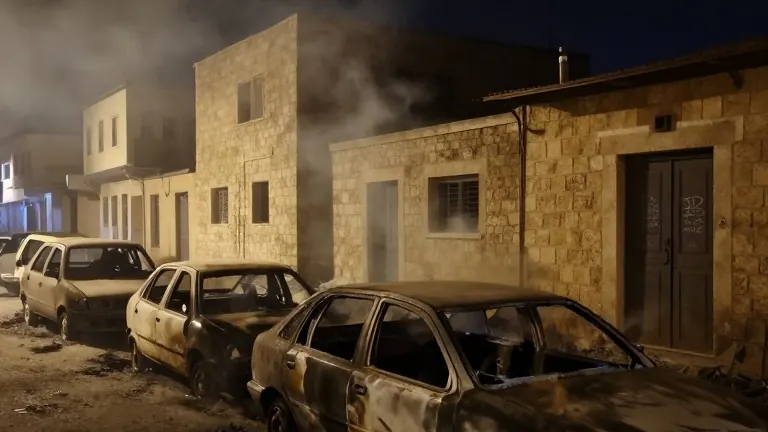
Gadi Eisenkot, the leader of the Yashar party, labeled a series of overnight arson attacks in the occupied West Bank as "Jewish terrorism in every sense of the word." He directed his criticism at National Security Minister Itamar Ben Gvir and Finance Minister Bezalel Smotrich, accusing them of driving the territory toward "unchecked anarchy." Eisenkot, who was assigned by President Isaac Herzog on 8 November to form Israel's next government, urged the security establishment to deploy administrative detention and Shin Bet operations against the perpetrators.
The violence erupted between Saturday and Sunday, targeting the villages of Deir al-Sudan, Deir Abu Mashal, and Kafr Malik near Ramallah. According to the Palestinian news agency Wafa, settlers set fire to 12 vehicles and sprayed racist graffiti on homes. Israeli police confirmed they opened investigations into the arson, vandalism, and property damage. Eisenkot wrote on the social media platform X that these sabotage acts undermine regional stability and damage Israel's foreign relations. He argued that the current reality is not inevitable but is instead the result of poor leadership.
Yair Lapid, another opposition politician, joined the condemnation. He described the incidents as "terrorism" born from government negligence. "By remaining silent, government ministers are deliberately encouraging these pogroms," Lapid stated. He pledged that when his faction helps form a government, it will restore law and order. The attacks occurred during a period of sustained escalation in settler violence across the West Bank, which has included assaults, farmland restrictions, and the expansion of settlement outposts.
The United Nations Office for the Coordination of Humanitarian Affairs (Ocha) recorded 40 settler attacks between 10 and 16 November. These incidents caused injuries to 38 Palestinians and displaced 68 people, including 31 children. During the 2026 olive harvest season, which ran from 1 September to 16 November, Ocha logged 428 such attacks. The disruptions have damaged agricultural property and hindered farmers' access to their land. October marked the highest monthly figure for settler attacks since Ocha began documenting them in 2006, with 467 incidents recorded that month.
Since January 2023, settler violence and access restrictions have displaced approximately 6,800 Palestinians across 137 communities. More than 3,200 of those displaced are children. In 2026 alone, the agency counts 2,894 displaced Palestinians. The Israeli settlement watchdog Peace Now reported that settlers have taken control of more than 100,000 dunams, or 10,000 hectares, of land in Areas A and B. Violence and threats have been used to restrict Palestinian access and pressure families to leave their homes.